Wednesday, August 29, 2018

On Diapers and Change


     When our first child was born, I briefly considered using some form of cloth diapering. “It is cheaper, you know, and better for the earth,” so said my conscience. But smelly diaper pails, the inconvenience of cloth, and the start-up price all deterred me. Disposables won out without much of a battle, especially after a stay-at-home mom told me how much she saved per diaper by using cloth.
     “I wanted to earn some money for my husband’s birthday present,” she said, laughing, “so every time I use a cloth diaper, he pays me the difference in what I save by not using a pamper. Silly, I suppose, but I like the feeling of having earned money of my own.”
     “How much per diaper?” I asked weakly, worried that her savings would be enough to arouse my conscience and make me reconsider cloth.
     She named the amount, a fraction of what I expected and less than a dollar a day.
     “Only that?” I said.
     “Yes. By the time you figure in soap and a little electricity for the washer, and if you use a cheap brand of pampers, the difference per diaper isn’t very big.”
     Her husband’s birthday gift, I figured, wasn’t going to be very big, either.
     Relieved that disposables were not such an outrageous expenditure after all, I happily pampered my first two children until they were potty-trained at the ripe old age of two.
     But our third-born came to us in West Africa where disposables are more expensive than the cheap options in the States and where trash multiplies nicely without my help. My conscience needed no prodding to come to life.
     I purchased square cloth diapers at my favorite market. I learned how to fold the squares to fit a baby through the tutelage of a veteran cloth-diapering-mom. Diaper liners were cut out of old clothing. My sister-in-law sent me diaper covers. I still had a month until the baby was born, so I practiced on a teddy bear who moved not at all while I worked and whose smile of yarn never left its face. This wasn’t going to be so bad after all.
     Plus (and I began to wear my chin with the tilt of being virtuous), there is nothing like knowing you are saving the trees and the earth.
     Then my baby was born. As soon as he grew big enough for the diaper covers to fit him, I outfitted him in his first cloth diaper. He even felt frugal when I picked him up. But from that very first diaper, I disliked every square inch of whiteness that bunched up on his little bottom and doubled its size. Disenchanted or no, I doggedly stuck with them, finding them tolerable during the day if I used disposables for going away and for the night.
     The best part of cloth diapering, I discovered, had nothing to do with a baby bottom and all to do with rows of white squares sunning on the wash line –the perfect picture of domestication. Nor did I mind extolling the virtues of cloth over disposable to my family who asked me how I liked them. “National Geographic’s Human Footprint estimates that each baby uses 3,796 diapers in its lifetime,” I told them. “And Pampers aren’t biodegradable, so in 500 years, they’ll still be around.”
     Gone green or no, I still disliked cloth diapers. I could tell the baby wasn’t fond of them, either, by the way he thumped his feet and fussed when I changed him, hampering the installation process. So much for the smiling teddy bear of my practice days.
     And then one day: I changed the baby and adeptly put the cloth diaper in place. My technique had improved with time. The wet diaper was dropped into a bucket of antiseptic water that smelled nothing like the diaper pail I dreaded. When it came time to do laundry, I discovered the system I developed for myself was working; I rarely had to rinse anything out or touch anything nasty, thanks to my homemade liners.
     It had been slow in coming, but I realized that I actually preferred cloth. I couldn’t believe it. But they were soft against his baby skin and not hard to deal with. The baby was growing fond of them, too, or so I thought by the way he thumped his feet happily when I changed him.
    I hope I can remember the lessons of the cloth diapers in the coming weeks: The hardest part of change is the learning curve. Kicking against the changes inhibits good things from happening in your life. Eventually, new things become normal and familiar —so much so that it is possible to start preferring the new over the old.
     In diapers, it just takes time, effort, and determination to forge through the tough days. In real life, there is grace (and other God-gifts) to add to that list. Thankfully. Because our family is facing a world of change.
    Our three-year commitment of service in Accra ends in two weeks. Replacements have already arrived and are co-living with us while we train them into their new role. We don’t doubt God’s leading, but even a God-led transition is laced with discomforts associated with change. That’s why I want to remember the lessons of the cloth diapers and walk through these weeks immersed in grace.
     Oh, the diapers? They changed, too. One day a little river of antiseptic water ran down the hallway and pooled under the baseboards. The baby howled to show his displeasure over his discovery. His daddy wasn’t happy, either, especially after he mopped for a half an hour to clean it up. A change occurred: the pail and white squares were (at least temporarily) archived.
     That might be the other valuable lesson of cloth diapers: Flexibility is one of your greatest assets.    

Thursday, August 23, 2018

Aburi Botanical Gardens

Photo credit: Jim Adamson
In our early days of living in Accra, we made a list of places we wanted to see during our three-year stay in Ghana. Now, with less than two months remaining, we are still working on completing that list. One of the places we finally visited was Aburi Botanical Gardens. Located on a high hill, the gardens were made in the 1870's for the refreshment of British officials back in the days when the Brits ruled Ghana. They picked a wonderful location; it was beautifully cool. 
I loved the entry with its stately palms
photo credit: Jim Adamson
Ghana, like most of Africa, has a lot of carved art, so it was fitting to come across a tree trunk carved full of animals and people. I wasn't sure if my children should be allowed to climb on it, considering the artwork, but then I saw that it was oiled and shiny from a thousand hands before theirs. 

One of the most unique trees, ever. The branches grow down,
making it confusing to know if they are roots or branches.
Our children's favorite tree was a hollow one they could climb in. 


Photo credit: Jim Adamson
Photo Credit: Jim Adamson
If you didn't mind getting dirty
(or risking a fall), you could climb all the way
up the inside of the tree. 
The sign explains the hollowness.
The strangler ficus surrounded, then strangled the host
tree, killing it and leaving nothing but this empty shell.

Darling little ice cream shop we patronized.
He is too skeptical of food to try my
ice cream but loved marching around
the veranda. 
Ghana doesn't have much evidence left of the British (Ghana won its independence from them in 1957), but the old buildings in the gardens spoke of an earlier era. So did the few interesting flowers. In their prime, the gardens used to be full of orchids and other flowers, but today there are hardly any remaining. 


The helicopter no one knows much about. Possibly a relic
from WWII.
One of our brilliant decisions of the day was to invite friends to go with us. Not only were they great company, Jim and Diane Adamson knew exactly where to find the gardens, eliminating detours we most surely would have taken. At our request, Jim took pictures of my two children with August birthdays and a couple bonus ones besides. 
Six years old!
photo credit: Jim Adamson
One year old!
Photo credit: Jim Adamson

Photo credit: Jim Adamson

Photo credit: Jim Adamson

Photo credit: Jim Adamson

Saturday, August 4, 2018

Homespun

Herald Press compiled an anthology of articles written by Anabaptist women. They selected all of the articles from two women's magazines, The Ladies' Journal and Daughters of Promise. The latter is a magazine I am a staff writer for, and three of my articles have been included in Homespun. I haven't had a chance to see my copy yet, thanks to living overseas, but here is a link for the newly released book. 


Monday, July 2, 2018

The Other Sara Nolt


     In my late teens, I was the secretary for my dad’s mechanic garage and needed to call an elderly lady named Sarah to update her on her vehicle’s status.
     “Hello,” I said when she answered. “This is Sara from LaVerne’s Repair, and I’m. . .”
     “Who is this?” she interrupted.
     I slowed down, something I have to do almost consciously sometimes. “This is Sara. I’m calling from LaVerne’s Repair.”
     “Ohhh!” Her voice dripped with relief. “For a moment I thought I had called myself.”
     Now, fifteen years later, I know how she felt. I recently wrote an email to another Sara Nolt, a person I expected to hear of sooner or later, considering my common Mennonite name. Before her existence was verified to me, I held the vague hope that she wouldn’t be a writer, thinking it would avoid confusion if she had other interests, like gardening, for example. No one could possibly confuse us then. But. . . no such luck.
     “You got a check in the mail today,” my sister told me. “It is from CLP’s Companions for a story you wrote.”
     I viewed the picture she included in the text, and didn’t recognize the title on the check stub. I hadn’t written the story. A few hopeful ideas came to mind. Maybe CLP had extra cash to send to their contributors and fabricated a title to fill in the blank. Or maybe the secretary’s finger twitched as she scrolled through lists of contributors and gave a random check to me. Or perhaps (gasp!) the confusion I feared had begun. And indeed it did. There is another Sara Nolt who writes. She lives in Ohio, CLP told me when they apologized for the mix-up.
     A single publisher is not alone in his confusion. Several months after I learned I had a twin, I got an email from my cousin in Belize, thanking me for a Christmas letter I did not send. I was puzzled for a few days until her explanation came –a flurry of words by way of apology. She has a friend, you see, in Ohio named Sara Nolt and we had both written around the same time and being great with child (pregnancy brain, you know), she was confused over which Sara she was writing.
     I asked my cousin for an email address and made contact with my twin. She responded yet that day with an introduction of herself and family: She is married and lives (surprise!) in Ohio. She does some writing, and includes her middle initial in her byline: Sara J. Nolt.
     And then she said it: “I read the book you wrote. It is a good booklet but I admit I wish you would have done a little introduction to the author in it. I had quite a few people thinking that I wrote it.”
     I froze. It is one thing for my story on overcoming a chronic problem to be aired publicly; it is quite another thing to taint a perfect stranger with my besetting sin. Though they felt insufficient, I offered my apologies for causing the confusion. She was gracious and kind –a likeable person to have as my twin. I want to meet her someday.
     To attach myself to the booklet (and free her from it), here it is: Overcoming Inferiority, for sale at Christian Light Publications for $3.95. You can click HERE for a link to it on their website.

Friday, June 8, 2018

Trashy Bags

Our little family will be moving back to the States, Lord willing, in late September of this year. Before our return, we have a short list of things we want to do or places we'd like to visit. The richness of living in another culture won't be ours for long and we want to take advantage of it while we can. 

One of the places I wanted to see was Trashy Bags, a small business that recycles plastic water sachets, billboards, and fabric scraps by turning them into purses, laptop bags, and more.


Water sachets, by the way, are sold all over cities and larger towns as purified water-to-go. The downside to this convenience is all the plastic left behind. Cheers, then, to creative recycling businesses such as Trashy Bags.

Even the baby loves drinking from
these sachets. 
I was happy to find a sleeve for my Kindle. They had one made from heavy canvas billboard material. It is strong enough and my Kindle feels secure enough that I think I could drop it from any bridge or building and retrieve it unharmed -a fitting defense for a library of much-loved books. 


Trashy Bags took us on a tour through their factory. Water sachets are sewn into strips and those strips into squares. 


One seamstress sewed zippers onto sachets in an unbroken string. 


Another woman does nothing but sews endless strings of handles. All the parts were then taken to two tailors who sewed reusable shopping bags, ones that can be folded and zipped into a small rectangle for convenient storage. 


The finished product. She is holding
an opened bag; the same bags are
displayed behind her, zipped closed.
 The bags that really caught my eye, though, were the ones made out of fabric scraps collected from seamstresses. The quilt-patch bags are stiff because they are lined with billboard canvas. 


"Our products are made from 90% recycled materials," our guide told us. "The zippers are new, the thread is new, and sometimes we use new fabric to line things like Kindle sleeves." 

Sophia summed it up pretty well by saying, "I think Ghanaians are so creative. They can take trash and turn it into something that is not trash." 

Wanna go shopping? 

Thursday, May 17, 2018

A Homeschool Mom's Education on Antlions


     As I pinned a shirt to the wash line, I saw Tyler coming to find me, a reading book in his hand. He needed to read aloud, but noticing I wasn’t ready for that, he deviated from the sidewalk and scuffed his foot in the dirt beside the house. He poked around for a minute, then asked, “Have you seen these bugs?”
     Considering they were hidden behind a stubby tree in the flowerbed, I hadn’t.
     “You really should see them. They make holes in the dirt and if you drop an ant into the hole, dirt pops up like a little volcano.”
     My eyebrows popped up, too, and soon I crouched behind the tree in the flowerbed while my young entomologist gave me a further education on antlions. Had I noticed them previously, I would have assumed that the pockmarks in the dirt were created by water dropping from the eaves. But, no. They were live traps, made by antlion larvae.
     “See? The walls of these holes are so steep that the ants can’t get back out.”
     We dropped an ant into one of the craters and watched it scrabble at the smooth sides. Then, suddenly, he said with his voice rising in excitement, “Look! The dirt is popping up!” Indeed! From the center of the hole, dirt was being kicked up a centimeter high, as if a mini popcorn popper was at work. This action helps knock the ant into mandibles waiting at the bottom of the hole. The antlion was having his lunch.
     It was my first encounter with antlions. Impressed with both the bug and my son’s knowledge of them, I changed the day’s penmanship assignment from copy work to writing a paragraph about this intriguing insect.
     As he worked, he said, “Mom, don’t you think antlions would make an interesting blog post?”
     I did. And so, with his permission, here is a picture and a small report, both courtesy of my son.

Backyard Volcanoes
Tyler Nolt, age 8
There are so many interesting bugs in Ghana.* This bug makes his house like a bowl of a funnel. If you put an ant in it, or if an ant crawls in it, it cannot climb out because the sides are so smooth. Then dirt shoots out like lava from a big volcano when the bug eats them. The name of this bug is called an antlion.

Tyler's picture of the lions' dens.
Our very own antlion.
Photo credits to Adriel.
*Antlions are found worldwide. In the States, the larvae are sometimes called doodlebugs because of the squiggly lines they make in sand. The adults look like a damselfly.

Friday, May 4, 2018

"I was sick and ye visited Me. . ."

. . .and other ways to care for a family in an emergency.
In the ambulance,
ready for an hour and a half drive

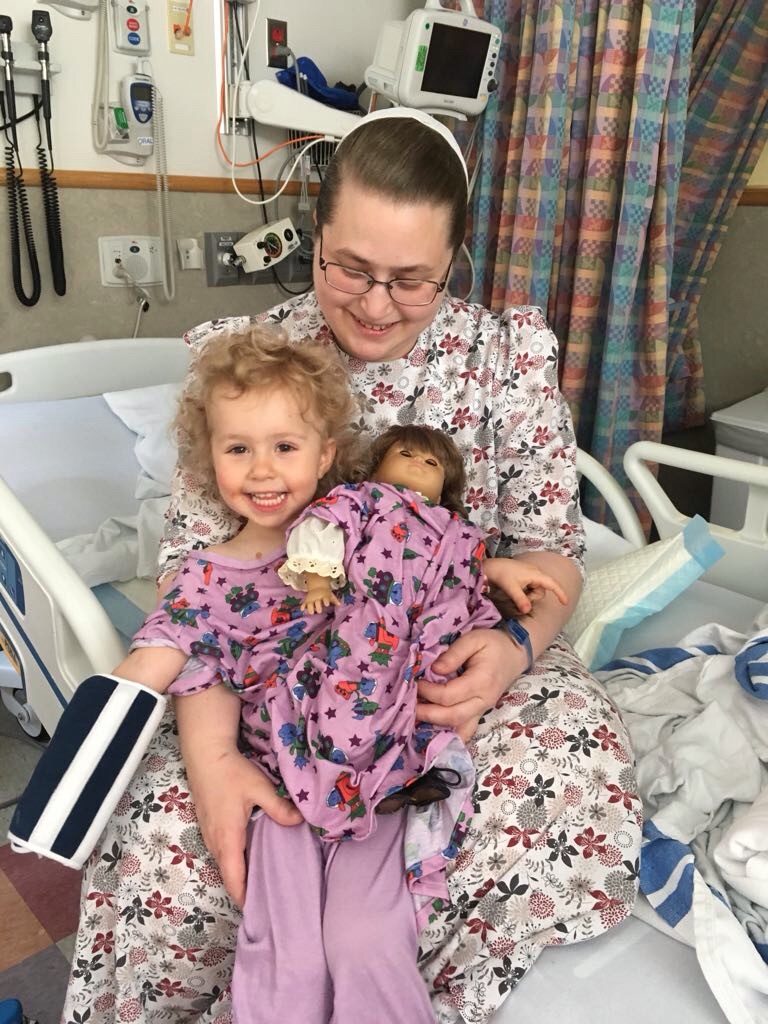
Too far away to do much more than pray, I kept checking my phone this past week for updates from my sister Laura. Her two-year-old daughter Deborah was recently diagnosed with hypoglycemia. The cause is still undetermined even after two traumatic ER visits, two lengthy ambulance rides to the Children's Hospital of Philadelphia, and over a week spent in the hospital. Deborah is home, thankfully, and doing well, though her parents live with the knowledge that her sugars might plummet uncontrollably and another hospital stay will be necessary.  
Listening to the doctor's heart
This isn't their first experience with hospital stays. Laura herself has been hospitalized eight different times and, no, not always with new babies to show for it. Knowing her history, I asked her for ways the rest of us can reach out to a family with a hospitalized member. Many of the following ideas were gleaned from her abundant experience, from acts of kindness gracious friends poured out on them during their medical crises. Truly, the beauty of the family of God is highlighted during an emergency. Denny Kenaston said, "God the Father is seated on the throne; God the Son is at His right hand. But where is the Spirit? You is the hands and you is the feets." One tangible evidence of His Spirit within us is when we find ways of caring for those in a crisis. 

At the hospital:
1.       Ask if visitors would be enjoyed.  If they are, make time in your busy schedule to pay them a visit.
2.       Communicate by text. Texts can be received anytime and read or responded to when they get the chance.
3.       Before you visit, ask if the caregiver (or patient) wants you to bring anything, either from home or the store.
4.       If your children are sick, leave them at home.
5.       Be aware that a hospitalized child might not be on their best behavior. Don’t go away appalled.
6.       If it is a child who is hospitalized, offer to babysit so the parents can have a little date.


Gift ideas:
Ideas are endless, of course, but here are a few proven to be successful.
1.       Deborah really enjoyed glo-sticks and helium balloons.  
2.       Give a box of small, wrapped reward gifts to be opened after painful or scary procedures. Deborah needed her blood sugar checked every three hours around the clock, had to have three IV placements, and one painful heel stick –the latter aggressive enough to fill a test tube with blood. Reward presents can (sometimes) save the day.
3.       If a small child is going to be in the hospital for a lengthy stay, give them a photo album of favorite people and places.
4.       No money? No worry. Take a pile of your own books to read to the child during your visit.
5.       Don’t forget the mom! Take snacks and books for her, too.
6.       Hospital food can get old after a while. Families of inpatients usually have access to a fridge and microwave in the family lounge. Take home-cooked meals for them to reheat.
7.       Can't be there in person? Order a gift from the hospital's online gift shop and have it delivered to the room. While selecting a gift for Laura and Deborah, we noticed that CHOP's online store also had $5 meal vouchers -another great gift idea. 
8.       If the hospital is far away from home, give gift cards for fuel.
9.       Offer rides. “I didn’t always have a car available,” Laura said, “so it was nice to have a friend from church offer take us to the ER.”
Gigi, the monkey, deserves
applause, too, for tirelessly
offering moral support. 


For those waiting at home:
Having a family member in the hospital is hard on the ones left back home. Don't forget them.
1.       Offer to go grocery shopping, or surprise them with a box of staple ingredients (and a few treats).
2.   Take them prepared foods like a hot supper or frozen meals. Supply them with convenient options for packed lunches.
3.       If the patient is hospitalized for an extended stay, volunteer to do something special with the little people left at home.
4.       If teens are shouldering the burden at home, find ways to recognize their service. My 18-year-old niece did a marvelous job of taking care of the home while her mother and sister were in the hospital for a week. But it wasn’t easy -especially since she was caring for a toddler with a stomach flu. Friends dropped by to visit, bring flowers, or to drop off a frappe. Their care renewed her courage.
4.       Offer to babysit the little ones still at home.
5.       Comb little girls for school or church.
6.       Offer laundromat services. Pick up the dirty laundry and return it freshly washed, ironed and folded.


 Afterwards:
Whew! They are finally home. But the family might not feel like everything is back to normal as quickly as the rest of us do. It might not just be curdled milk and fossilized leftovers that need to be sorted out; hospital stays can be exhausting emotionally, too.

1.       Offer your services. Need a hot meal? Laundry washed? Groceries? Depending on the situation, they might be exhausted or simply overwhelmed at trying to catch up.
2.  Text, call, or stop by. Sometimes a mother needs to unwind, to debrief. Show your support by lending a listening ear.
  3.   In the event of an ongoing medical problem, don't wait for a crisis to show your love and support.

Jesus said, "I was sick and ye visited me." Then said they, 'Lord? When did we see you sick?' And Jesus said to them, "As often as you did it to the least of these, you did it to Me."
(paraphrased from Matthew 25)

    All photo credits go to Laura. She read and approved this post.